
September 16, 2025 | Miami, Florida, United States | Libna Stevens, Inter-American Division News
Seventh-day Adventist leaders in the Inter-American Division (IAD) have taken a bold step to support literature evangelists (LEs), approving major policy changes and updates to strengthen and protect their ministry. The move directly affects hundreds of full-time LEs across the territory.
Union presidents and publishing ministries directors reviewed more than 80 pages of policies, removing outdated language and resolving ambiguities that had persisted for over a decade.

The advisory meetings, held September 1–3 in Miami, Florida, brought together union leaders and editors from the IAD’s two publishing houses, IADPA and GEMA, to discuss the revised policies. Together, they oversee 5,886 literature evangelists, including 1,273 full-time, 2,604 occasional, and 2,009 student canvassers.
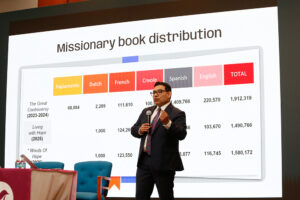
“Our publishing ministries policies are extensive. Many administrators and leaders in the territory get confused as they move from one section to the next, because we found inconsistencies and contradictions within the same policies,” explained Espinoza.
“The publishing ministries policies are the longest in the IAD policy book, totaling 84 pages,” he added. “For comparison, the General Conference has only 13 pages. We have worked hard to study each policy and have reduced ours to 60 pages, keeping the structure aligned with the GC’s guidelines.”

Major Policy Changes
Leaders approved four significant changes to the publishing ministries policies, including a new structure for the 1 percent of tithe funds allocated to each union or field. Under the revisions, 20 percent of the funds will go to the retirement fund for eligible literature evangelists. The previous allocations—45 percent for basic needs and 35 percent for professional formation—were removed, giving unions and local fields greater flexibility to use the remaining 80 percent according to their local priorities.
Espinoza explained that full time literature evangelists have been receiving medical, educational, rent, and travel assistance. Under the revised policy, rent and travel allowances will no longer be included, as literature evangelists are not considered church employees and fiscal regulations vary across countries. Medical and educational allowances remain unaffected, as they are provided directly to the institutions offering those services, avoiding legal complications in different regions, leaders said.
Read the full article at interamerica.org.